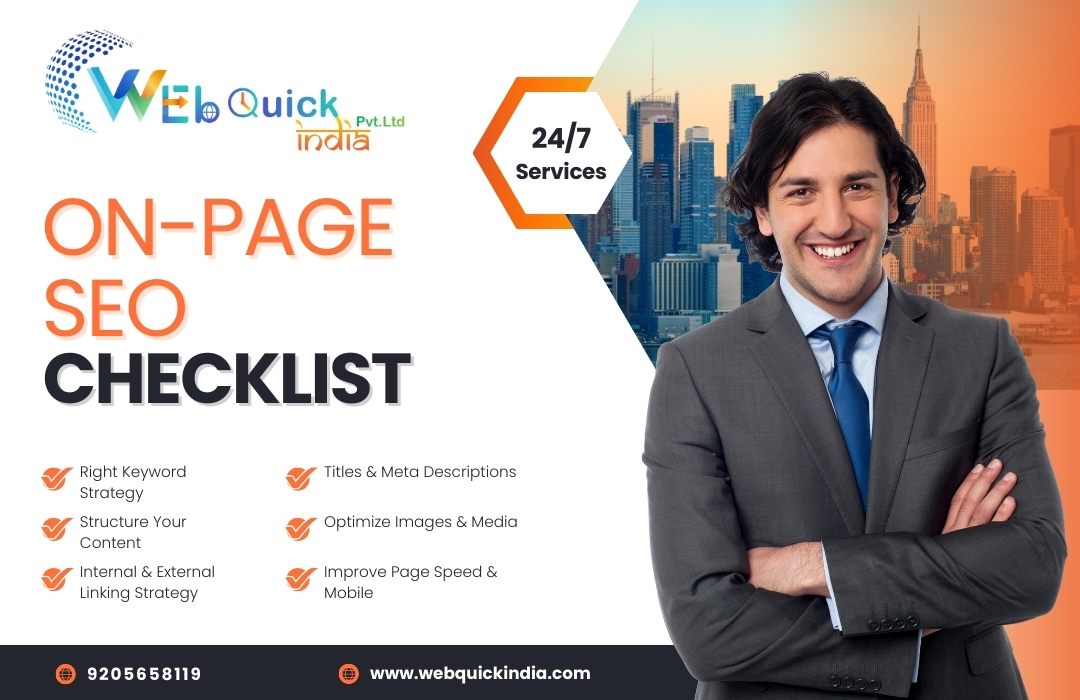
On-Page SEO Checklist: A Practical Guide by Webquick India to Rank Higher and Convert Better
Your website traffic, leads, or sales nothing — it is likely that your on-page SEO has not been set up properly. A large number of business owners spend money on ads, new designs, and social media, but the most important factor of gaining visibility — proper optimization for every page — is still ignored.
Webquick India has provided services to customers from various sectors and the same problems are always present: absent meta tags, poor quality content, delayed pages, fractured structure, and no genuine plan at all. The silver lining is that rectifying on-page SEO is not that hard or complex — if you have a clear, step-by-step checklist to follow.
This guide will walk you through a complete On-Page SEO Checklist, designed to improve visibility, user trust, engagement, and conversions.
1. Start With the Right Keyword Strategy
The process of on-page SEO starts right at the moment you begin composing. Keyword selection is critical and if it’s wrong no amount of great content will bring you results.
✔ Selecting Primary & Supporting Keywords
• One main keyword
• 2–4 supporting (LSI)keywords
• Pay attention to search intent (what users actually want)
To illustrate:
Main: on-page SEO checklist
Support: SEO best practices, optimize website pages, on-page ranking factors
✔ Steer Clear of Keyword Stuffing
Google’s favorite is the natural language. Write primarily for the readers and only then, after that, modify it for SEO purposes.
👉 Tip from Webquick India:
Employ the likes of Google Autosuggest, People Also Ask, and free keyword tools to get a good grasp of what users are searching for.
2. Create Strong Titles & Meta Descriptions
The title and meta description you provide will ultimately be the factors that attract users to your page — or to that of your rival.
✔ Page Title (50–60 characters)
• Your main keyword should be there
• Use human language to entice readers rather than using cold AI language
• When appropriate, include your company name
Example:
On-Page SEO Checklist for Higher Rankings | Webquick India
✔ Meta Description (140–160 characters)
Let the advantages be understood and invite action.
Example:
Get the whole on-page SEO checklist to bring about improvements in ranking, traffic, and conversions. Tips for experts by Webquick India.
Clever titles lead to increased CTR, and higher CTR leads to improved ranking — a win-win situation.
3. Structure Your Content for Users & Google
Google appreciates neat and well-structured content.
✔ Implement One H1 Only
Your H1 should convey the principal theme — and not your brand's famous saying.
✔ Make use of H2 & H3 Subheadings
They assist:
• Readers to review swiftly
• Google to grasp your page
Divide the text into concise paragraphs, bullet points, and logical segments. Long text drives users away — and causes a rise in bounce rate.
4. Write Helpful, Engaging, User-Focused Content
Search engines reward websites that offer real value.
E-E-A-T (Experience, Expertise, Authoritativeness, Trustworthiness) means:
- Share real experience
- Provide expert explanations
- Back claims with facts
- Show transparency
✔ Make Content Problem-Solving
AI text conversion is by no means a perfect process, as it sometimes generates results that are too close to human-written text or fall short of human quality. However, in the case of the present text, AI has reframed it quite well, hence giving us the same number of words and presence of HTML elements. Here is the final output:
The questions starter should be as follows:
• “What should I do first?”
• “How does this help my business?”
• “What mistakes should I avoid?”
✔ You should always think about Depth (900–1200+ words)
Longer content is ranked better when it is useful — not when it is filled with fluff.
👉 At Webquick India, user intent is always our priority, then the algorithm.
5. Optimize Images & Media
Images make content engaging — but they also impact speed and SEO.
✔ Follow These Essentials
- Compress images to reduce load time
- Use descriptive filenames
(Example: on-page-seo-checklist-webquick-india.jpg) - Add ALT text with natural keywords
- Avoid oversized or irrelevant graphics
Fast-loading visuals improve user experience — and ranking signals.
6. Internal & External Linking Strategy
Smart linking not only fortifies authority but also facilitates users to navigate through the website more easily.
✔ Internal Links
Lead users to helpful pages that are related.
Illustration: blog → services → case studies.
✔ External Links
When necessary, link to trustworthy and high-quality sources. This helps to build credibility and trust.
Do not include links that are spammy or not relevant. The quality of links is more important than the number of links.
7. Improve Page Speed & Mobile Experience
Most visitors leave if a website loads in more than 3 seconds.
✔ Key Technical Factors
- Mobile-friendly responsive design
- Optimized images & scripts
- HTTPS secure site
- Avoid unnecessary pop-ups
Google now ranks mobile performance first, so your site must work flawlessly on smartphones.
8. Use Schema Markup (Structured Data)
Schema helps search engines understand your page better — improving visibility with rich snippets.
Useful types:
- Local Business schema
- FAQ schema
- Service schema
Webquick India recommends adding schema for every important page — it boosts trust and click-through.
9. Local SEO Essentials (Especially for Service Businesses)
When focusing on the local audience, on-page SEO should play an essential role in it.
✔ Add Local Signals
• Subtly use city/zone keywords
• Name, Address, Phone (NAP) regular
• Google Business Profile link
• Map embed where applicable
Illustration of the term:
Digital Marketing Services in India — Webquick India
Local visibility means more calls, more leads.
10 Strong Call-to-Action (CTA)
Traffic without conversion is wasted effort.
✔ Always Guide the User
Examples:
- Get a Free SEO Audit
- Request a Quote
- Call Now
Make CTAs visible, relevant, and honest — never pushy.
11. Final On-Page SEO Quality Check
Before publishing, review:
- Grammar & readability
- Natural keyword placement
- No duplicate content
- Working links
- Correct headings
- Updated date
- Clear purpose on the page
Remember: SEO is not tricking Google — it’s helping users and Google understand your page better.
Why Webquick India Recommends This Checklist
The reason for this is very simple: it works — every time.
Companies following this on-page SEO checklist get the following results:
✔ Improved positions for keywords
✔ Increased number of visitors through organic search
✔ Longer stays on the website
✔ Greater trust and more sales
And, above all:
They create a site that actually meets the needs of the users.
Final Thoughts
On-page SEO is not just about rankings — it’s about making your website clear, helpful, fast, and trustworthy. When your content answers real questions and follows best practices, Google rewards it naturally.
If you want hands-on help implementing this checklist, improving content, or auditing existing pages — Webquick India can assist with complete on-page optimization, content strategy, and performance tracking.
FAQs — On-Page SEO Checklist (Webquick India)
1. What is on-page SEO and why is it important?
On-page SEO means optimizing the content, keywords, headings, images, meta tags, internal links, and user experience of the entire web page in such a manner that all elements are optimized.
2. How long does it take to see results from on-page SEO?
Most websites witness enhancement in their ranking within 4-8 weeks, depending on factors such as content quality, competition, and the overall strength of the website.
3. How many keywords should I use on one page?
Concentrate on:
• 1 main keyword
• 2–4 supportive / related keywords
Steer clear of keyword stuffing. Write fluently — optimize only where it is valuable.
4. Does longer content rank better?
Yes, long-form content (900–1,500+ words) which is helpful usually gets better rankings since it provides answers to more user questions. However, quality is more important than quantity; always write for the reader first.st.
5. What is E-E-A-T in SEO?
E-E-A-T stands for Experience, Expertise, Authoritativeness, Trustworthiness.
Google rewards websites that:
- Show real experience
- Provide expert insights
- Use credible sources
- Build trust with clear information
Webquick India applies E-E-A-T principles across all pages for stronger credibility.
6. How important are meta titles and descriptions?
Very important. They influence click-through rate (CTR).
A strong title + description helps users choose your page over competitors — and better CTR can boost rankings.
7. Do images affect on-page SEO?
Yes. Properly optimized images (compressed, named correctly, ALT text added) improve speed, accessibility, and ranking signals.
Unoptimized images slow the site and reduce performance.
8. What is schema markup and do I need it?
Schema markup (structured data) helps Google understand your content and display rich results like FAQs, reviews, and business info.
Local businesses and service pages benefit the most — Webquick India highly recommends it.
 our blog
 Webquick
India
Webquick
India
 10 Oct 2026


 How It works